Hwaseong Fossilized Dinosaur Egg Site (화성 공룡알 화석지)
Gyeonggi · 659, Gongnyong-ro, Hwaseong-si, Gyeonggi-do
Hours
09:00-17:00 (Winter 10:00-17:00)
09:00-17:00 (Winter 10:00-17:00)
Address
659, Gongnyong-ro, Hwaseong-si, Gyeonggi-do
659, Gongnyong-ro, Hwaseong-si, Gyeonggi-do
Parking
Available (29 parking spaces: 4 spaces for large-sized cars / 25 spaces for small & middle-sized cars)
Available (29 parking spaces: 4 spaces for large-sized cars / 25 spaces for small & middle-sized cars)
Overview
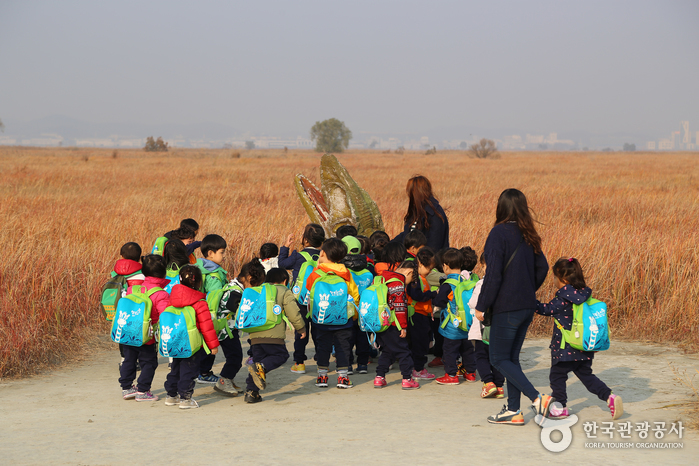
The Hwaseong Fossilized Dinosaur Egg Site was discovered on an island in the tidal plain south of Sihwaho Lake. The island was revealed when seawaters were blocked during a land reclamation project. As the sedimentary layer formed during the Cretaceous period of the Mesozoic Era (dated around 83 million to 85 million years ago) was eroded by weathering, roughly 200 dinosaur eggs in thirty nests were discovered at twelve dig sites. It is anticipated that more fossils will be discovered once a thorough investigation is carried out and more land is reclaimed.
<br><be>
Most dinosaur eggs are oval shaped and dark red. Considering the properties of the fossilized shells, the eggs that have been discovered so far are assumed to belong to four-legged herbivorous dinosaurs with a long neck and tail, and two-legged herbivorous dinosaurs, including the hadrosaur. A wide range of plant fossils were also discovered alongside the fossilized eggs, leading to expectations that the formerly lush environment may yet be restored.
<br><br>
The discovery of the Fossilized Dinosaur Egg Site in Hwaseong has greatly expanded the scope of Korean paleontology; previous paleontological discoveries were exclusively limited to fossilized dinosaur footprints. This significant discovery has attracted many internationally renowned scholars who have visited the site in Hwaseong.
<br><be>
Most dinosaur eggs are oval shaped and dark red. Considering the properties of the fossilized shells, the eggs that have been discovered so far are assumed to belong to four-legged herbivorous dinosaurs with a long neck and tail, and two-legged herbivorous dinosaurs, including the hadrosaur. A wide range of plant fossils were also discovered alongside the fossilized eggs, leading to expectations that the formerly lush environment may yet be restored.
<br><br>
The discovery of the Fossilized Dinosaur Egg Site in Hwaseong has greatly expanded the scope of Korean paleontology; previous paleontological discoveries were exclusively limited to fossilized dinosaur footprints. This significant discovery has attracted many internationally renowned scholars who have visited the site in Hwaseong.
Location
📍 Open in Google MapsHow to Get There
Info: • 1330 Travel Hotline: +82-2-1330 (Korean, English, Japanese, Chinese) • For more info: +82-31-5189-3508~6
Best Time to Visit
South Korea has four distinct seasons. Spring (March–May) and autumn (September–November) are the most popular times to visit. Summer brings humidity and occasional typhoons, while winter is cold but great for ski resorts and festivals.
Frequently Asked Questions
09:00-17:00 (Winter 10:00-17:00)
Available (29 parking spaces: 4 spaces for large-sized cars / 25 spaces for small & middle-sized cars)
Mondays, New Year's Day, Seollal (Lunar New Year's Day) & Chuseok (Korean Thanksgiving Day) holidays
• 1330 Travel Hotline: +82-2-1330
(Korean, English, Japanese, Chinese)
• For more info: +82-31-5189-3508~6
(Korean, English, Japanese, Chinese)
• For more info: +82-31-5189-3508~6
Photos
© Korea Tourism Organization · Source required · No modifications